Tuesday, October 8, 2013

Best Buy's Vending Machines

John and I spent last week in Minneapolis.  Though I did bring home some city boogers as souvenirs, we had a great time on our little jaunt in the big city. I've got several posts in mind about the trip, but let's begin here. . .

For those of you who, like me, have never seen one of these, this is a Best Buy vending machine.  This one is located in the Little Rock airport, though I saw several during the course of our trip. Items for sale include iPods and $300 Beats headphones among other things.

If you're thinking "Oh, I can't wait to hear what this crazy, homestead-y, blogger girl has to say about this!", you may be disappointed.  I will say I couldn't shake it -- just kept thinking about it and what it might say about us as a society.  There's a great essay to be found in it all, I think. If only I had the time!


But, I would like to offer the words to a song I'd never heard before we attended Hennepin Avenue United Methodist Church in Minneapolis last Sunday . . . 

Simple Gifts:  Shaker Song

'Tis the gift to be simple, 'tis the gift to be free, 'tis the gift to come down where we ought to be, and when we find ourselves in the place just right, 'twill be in the valley of love and delight.
When true simplicity is gained to bow and to bend we shan't be ashamed, to turn, turn, will be our delight till by turning, turning we come round right.

Monday, October 7, 2013

So Much Soap!


Since school started, Thursday has become Soap Day.  I've churned out about 16 batches of soap so far, and my drying rack is nearly completely full!

Soon, I'll have bars ready to package and will be looking for a good way to sell them. My current plan is to see whether any local boutique-type places might be interested in stocking them. I'd considered an Etsy-type store for online sales, but I really don't think they'd ship well.  Any other ideas?


Saturday, October 5, 2013

White River Community Garden

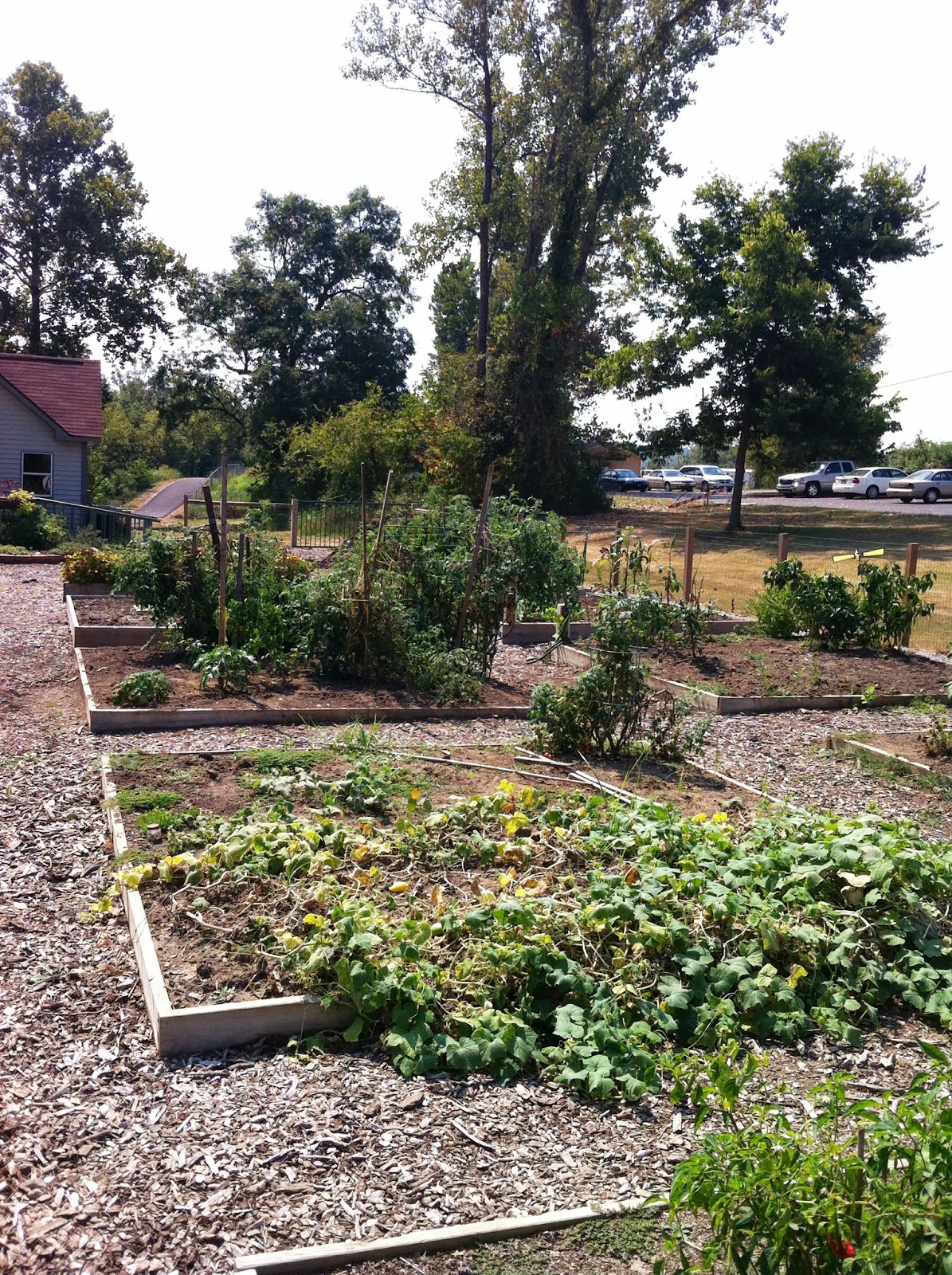
This past week, I found myself needing to kill a little bit of time in Batesville between doctor's appointments (long story -- another time).  As it was lunchtime, I picked up a to-go lunch and headed to a spot with a nice view.  Some folks may head to the river or the park.  I drove right over to the White River Community Garden.  I was able to enjoy my lunch while checking out what everyone is growing and how they're trellising and mulching and more.


I don't actually need a garden bed at the community garden, but I was interested to know more about how it works, so I decided to call the number listed on the sign and check it out.

What I found out was so great, that I thought I'd pass it along to you guys in case anyone would like to take advantage of this great opportunity!


The large beds are 10'x10' and cost $35 to rent for the year.   
The smaller beds, at 10'x4', are $20.  
Each bed has its own water hydrant (as pictured above), and water is included in the rental fee.  

I mean, seriously!  Do you know how much food you can grow in a hundred square feet?!?  
If you live in town but don't have the space to grow your own garden, this is a great option. I would also think this would be great for the beginning gardener.  You wouldn't have to put any money into the start-up infrastructure of garden bed and basic soil, and you'd have the added benefit of having your garden surrounded by other gardens that you can watch and learn from throughout the growing season.  If you're out there harvesting or tending while other gardeners are present,  you can even exchange gardening tips along with pleasantries.


The rental is for a calendar year, so call Sharon Clark, an Independence County Master Gardener in January to secure your plot for 2014.  She can be reached at (870) 251-2148.

If you aren't a local reader, look into community gardening in your area.  It's becoming very popular.  I'll bet if you do some digging, you can find something similar available in your hometown.  And, if not . . . maybe you could get one started.  ;)

Friday, October 4, 2013

Intrinsic Benefits of Gardening


According to the Horticultural Society of New York, which has practiced "horticultural therapy" with Rikers Island inmates since 1989, the list of benefits is a long one:  "stress reduction, mood improvement, alleviation of depression, social growth, physical and mental rehabilitation and general wellness."

Wow!  Well, there you go.  No wonder I'm in such good mental shape!  ;)

Could you use a little stress reduction and mood improvement?

If you've ever thought about gardening but don't know where to begin, check back in tomorrow.  I've got just the solution for you.  :)


Thursday, October 3, 2013

DIY Frozen Yogurt (New and Improved)

Last year, I posted this recipe for strawberry frozen yogurt.  And, while this recipe does make a very yummy product, I've found a new one that is more resourceful, so I thought I'd pass it along.

The problem with the old recipe is that it calls for sweetened condensed milk.  This product can get pricey when you're throwing in 3 cans per batch of yogurt. I love the new basic recipe because it uses plain 'ole sugar as the sweetener.  The recipe calls for "caster sugar," which is basically sugar that has been processed so that it's consistency is somewhere between that of granulated sugar and powdered sugar.  This just-right sugar helps the yogurt to freeze into a nice consistency.  I didn't have any caster sugar, so I made my own.  You can do the same.  Just whirl your granulated sugar around in your food processor for a minute or two, allow the dust to settle before removing the lid, and, voila!, caster sugar!  I processed a bunch and keep it in a mason jar in the pantry so that it's always ready for a batch of yogurt.

Chocolate Frozen Yogurt
2 cups (or 16 oz.) yogurt

4-5 tbsp cocoa powder

1/2 cup caster sugar (or to taste)

1/2 tsp vanilla extract

1/4 tsp salt


Strawberry Frozen Yogurt

2 cups (or 16 oz) yogurt

1/2 cup caster sugar (or to taste)

1 tsp vanilla extract

1 1/2 tbsp lemon juice

1 cup fresh/frozen strawberries, pureed  (You can basically sub in any fruit here.  

We've done a batch of mixed berries that turned out great!)


What I love about this recipe is that you can just play with it.  Here is a mid-process batch of lime frozen yogurt.  (John loves those Edy's frozen lime bars, so I thought I'd try this for him.)  I basically used the fruit recipe above (minus the vanilla) and added frozen limeade concentrate in place of the fruit.  

You can double or triple the recipe to make a decent-sized batch.  Just combine all ingredients and process in your ice-cream maker like you would ice-cream.  Enjoy!

Thank you to "To Food with Love" for the original recipe.

Wednesday, October 2, 2013

Simple Tips for Curbing Your Food Waste

So, if you read yesterday's post, you know that the average American household tosses about 14% of its food.  Here are some ideas we try to employ so that our household percentage is much lower that that . . .

1.  Make a meal plan -- If you know me at all, you had to know this one was coming -- I'm definitely a planner.  We've all been there:  the recipe calls for fresh cilantro, but it comes in a bunch.  So, once you've made that salsa, the rest of the herb bunch just sits in the crisper drawer until it eventually finds its way down the garbage disposal.  Be proactive.  Plan your weekly menu so that there's minimal waste.  At our house that might mean that we have Mexican food the same week we have potato salad because I know that we won't use all of the sour cream with our tacos, so I'll have just enough leftover to make the potato salad later in the week.

2. Plan meals that keep well as leftovers -- Interestingly, this may also keep your meal plan a little healthier.  We all know that fried foods don't store well -- that's how you justify eating just one more piece of fried okra, right?  "It won't be any good tomorrow!"  If fried foods aren't a part of the meal plan to begin with, then you won't have that moment of horrible guilt involved with chucking all the leftovers down the disposal.

3.  Buy the amount you need -- "Oh, this new variety of kale is on sale if I buy the big bag!"  Hmmm.  It's not a great deal if some of it is likely to go bad before your family can eat it all.  This is not really the case with non-perishables.  If your favorite brand of whole-grain pasta is on sale in bulk, you snatch that stuff up!

4.  Stick with your plan --  This one has been a challenge for us at times.  If you plan to make a meal at home, don't make a spur-of-the-moment decision to do otherwise.  We've been guilty in the past of having some chicken marinating in the fridge but deciding to eat out.  Because of our schedules that week, we weren't able to get to eating the chicken in a time-frame that I felt was safe, so I had to toss it.  When you make your weekly plan, do so with your schedule in mind.  If, realistically, you probably won't have time to cook the spinach gratin you'd had in mind for Wednesday night, don't buy the spinach.  And, if you do buy the spinach, eat the spinach (and not a bean burrito at the local Mexican restaurant).

5.  Consider serving items separately -- I have a great pasta salad recipe that my entire family loves.  The only problem with it, though, is that it has spinach in it.  Once it's all mixed together, we have to eat it all since the spinach won't store well once it's dressed.  Finally, I discovered (and, yes, it took me longer than it should have) that if I served the spinach alongside the rest of the salad, so that it's added to each plate rather than to the salad bowl, I can store the leftover salad and the leftover dry spinach separately as leftovers: problem solved.  This technique could be handy with lots of salads and perhaps some other dishes as well.

6.  Effectively store leftovers -- Obviously, this means that your storage containers should actually do a good job of keeping food fresh for awhile.  But, it also means keeping food visible and easy to access.  I love my Pyrex glass storage containers because they are clear, make items easy to identify, and can be microwaved.  If you don't know what's in a container, you're not likely to grab it for a quick snack.  Also, consider storing food in serving sizes.  My oldest two kids are old enough to work the microwave on their own.  So, I trust them to grab an individual serving of last night's man-n-cheese out of the fridge and reheat it.  I DO not trust them to pull out the 9x13, get down a bowl, scoop out a decently-sized portion, and reheat it.  The easier it is to get the food from fridge to mouth, the more likely it is to be eaten.

7.  Have a "makeover" plan for leftovers -- If we only have one or two servings of something leftover, we will just stick it into the fridge.  But, if we've made so much that we can eat it again, it either needs to be brought back to the table for an encore or it needs to be reworked.  Maybe last night's pork becomes tonight's barbecue sandwich, for example.  This is an especially good plan if one of the people you're feeding is "anti-leftover."  It sounds terrible.  I'm so glad we don't have any of those eaters at my house, but I do know they exist.  Just dress last night's dinner up as something else, and they'll be none-the-wiser.

8.  Build in a day/meal for "fending" -- I do not cook (at home) on Sundays. This is the day that we "fend."  Growing up, my mom would use this term to mean that we were all just fending for ourselves.  So, Sunday after church, all the leftovers from the week are pulled out of the fridge and laid out buffet-style on the kitchen counter. First come, first serve- everyone gets his pick of favorites from the week.  If we did not allow this buffer day in the weekly menu, there would be lots of leftovers that would go untouched and have to eventually be thrown out.

9.  Produce your own food -- Obviously, there are lots of reasons to grow your own food, but a desire to waste less is definitely on the list.  I dare you to try to stuff chicken you produced in your own yard down the garbage disposal, guilt-free.  It's not going to happen. You will do your darnedest to be sure NONE of that chicken (or lettuce or milk or  . . . ) goes to waste.

10.  Feed an animal -- Even if it's just your dog, feeding leftovers that are maybe a day too-far-gone for human consumption is one way to avoid waste.  Sure, you may not be eating it, but it's at least saving it from being added to a landfill and saving you the cost of one of Fido's meals.  Do one step better and feed your leftovers to an animal that will in-turn feed you, such as laying chickens or a backyard dairy goat. If you have no animal to feed (or a finnicky one that will only eat his favorite brand of chow and turns up his nose at your kitchen scraps), consider starting your own compost pile.  The scraps may not be making it immediately to your mouth, but once you've used the compost on next year's garden, it'll get there!

Got any other tips for avoiding personal food waste that we could add to the list?

Tuesday, October 1, 2013

Our Excessive Waste

Picture the contents of your refrigerator.  Or, better yet, go open it up and take a look.  How much of what's in there will end up in the trash or down the garbage disposal.  Be honest.  10%?  20%?  More?    According to University of Arizona research, the U.S. average is 14%.   Sure, consumer food waste is a problem that we can easily take charge of in our own homes, but consider all the food waste that occurs before we even have a chance to stock our fridges and pantries.


Grocery stores account for a huge amount of food waste.  Have you heard of the recent trend of dumpster diving?  Those in favor claim that they can dine like kings just by hitting up the dumpster behind their local grocery stores -- where arbitrary sell-by dates or damaged packaging leave perfectly good food in the trash.

But, until I began my own garden, I hadn't really considered the food waste that occurs before food ever makes it to the store.  Our first year to garden, we were constantly snapping pictures of oddly-shaped vegetables.   I know this sounds naive, but it took me a few photo shoots with misshapen squash to get it -- it's not that MY vegetables are weird . . . it's that my perception of what vegetables should look like has been shaped by what I see at the supermarket . . . and the weirdo cucumbers never make it there.   "The NRDC estimates that 20% of fruits and vegetables are lost on the farm."   If a tomato has a small blemish, it doesn't make it to market.  Those of us who grow our own know that all it takes is trimming off the bad spot to get that tomato salad-ready.

While we can do a better job of managing our own food waste, solving the problem on a larger scale is a much bigger challenge.  Luckily, folks like Doug Rauch, the former CEO of Trader Joe's, has some ideas.  He has "announced his plans to open a 10,000-foot market in the disadvantaged Boston neighborhood of Dorchester, selling food during the fragile window after its sell-by date but before it has actually spoiled."  This type of store has already proven successful in several European countries.

Check back in tomorrow for a couple of practical tips on cutting down your own family's food waste.

Thank you to the always-amazing Modern Farmer for all the above info I got from your article "Junk Food" in your Fall 2013 publication.