Saturday, August 18, 2012

Our Prized Goat

Goats run in a herd.  That's just part of their genetic makeup.  Our goats apparently think that WE are part of their herd.  So, though they have a great, big field to enjoy all day long, they often choose to pile up right by the fence, like this, so that they can see us when we come outside and beg for scratches behind the ears!
Yesterday on the phone, I was talking to the farmer we bought our goats from back in April.  She was telling me how fortunate we are to have Razz, our sweet milker.  She hails from Pruittville Farms, which is one of the really big names in the National Dairy Goat Association.  Apparently, a yearling from Razz's bloodlines won some pretty prestigious awards this year in show, and Mr. Pruitt called our breeder and asked to purchase Razz back from her because of her excellent bloodlines.

Luckily for us, she'd already been sold to us, and we have no intentions of letting her go!  As novice goat owners, we're much more interested, though, in her sweet personality than in her bloodlines.  Still, it's kind of cool to own a goat the Mr. Pruitt is a little envious of.  :)

Friday, August 17, 2012

10 Reasons to Eat Local

I came across this list in some recent research I was doing, and was so encouraged by it that I wanted to jump in my car and head to the nearest farmer's market!  Read on, and maybe you'll want to do the same. . .

10 Reasons to Eat Local

1) Locally grown food tastes and looks better because crops are picked at their peak.
2) Local food is healthier. The shorter the time between the farm and your table, the less likely it is that nutrients will be lost from fresh food.
3) Local food preserves genetic diversity. Smaller local farms often grow many different varieties to provide a long harvest season, an array of colors, and the best flavors.
4) Local food is safe. Considering the recent e.coli. contamination, this issue is becoming more of a concern to consumers. When consumers support a local grower they know the source of their food and can look the farmer in the eye.
5) Local food supports local families. Local farmers who sell direct to consumers cut out the middleman and get full retail price for their food – which helps farm families stay on the land.
6) Local food builds community. Consumers gain insight into the seasons and the land on which the food grew. Local food systems provide an opportunity for education because they allow access to a place where people can go to learn about nature and agriculture.
7) Local food preserves open space. When farmers get paid more for their products by marketing locally, they’re less likely to sell farmland for development.
8) Local food keeps taxes down. Farms contribute more in taxes than they require in services, whereas most development contributes less in taxes than the cost of required services.
9) Local food benefits the environment and wildlife. Well-managed farms conserve fertile soil and clean water in our communities. The farm environment is a patchwork of fields, meadows, woods, ponds and buildings that provide habitat for wildlife.
10) Local food is an investment in the future. By supporting local farmers today, you are helping to ensure that there will be farms in your community tomorrow.

Thursday, August 16, 2012

Skip the Blue Box: Homemade Mac-n-Cheese

Why go to the blue box for macaroni and cheese when making it yourself is this easy?  I have another homemade mac-n-cheese recipe that is delicious, but it is much more involved.  This one was easy enough that I could throw it all together for lunch yesterday with the kiddos.
Ingredients:
3/4 c. uncooked macaroni pasta
1/4 c. butter
1/4 c. flour
1 tsp. salt
1/4 tsp. pepper
1/2 tsp. onion powder
2 c. milk
1 1/3 c. shredded cheddar cheese (I actually used 1/2 cheddar, 1/2 goat milk mozzarella)
1/2 tsp. ground mustard (I've never seen this used in mac-n-chz, but it made a great addition!)
4 dashes Worcestershire sauce
4 dashes hot sauce
bread crumbs (optional)

Directions:
1. Preheat oven to 400 degrees.  Grease bottom of a small casserole dish or the bottom of 4 oven-safe soup bowls.
2.  Cook pasta to al dente, about 8 minutes.  Drain and set aside.
3.  In a saucepan, melt the butter over medium-high heat. Stir in the flour and cook this roux for a couple minutes, stirring constantly.  Whisk in the salt, pepper, onion powder, and milk.  Cook and stir for another 2 minutes. 
4.  Reduce heat to low and add the cheese, mustard, Worcestershire sauce, and hot sauce.  Stir in the macaroni.
5.  Spoon into baking dish(es), sprinkle with bread crumbs (if using -- I didn't), and bake uncovered for 10-15 minutes, until bubbly.

Mmmm.  Luckily, the kids were turned off by the browned part, so I got it all to myself.  (Little do they know, it's the best part!) 

This recipe made just enough for the 3 kiddos and myself for lunch, but our portions weren't huge.  If serving the entire family, I will probably double it. 

I really think the little zings of mustard, Worcestershire, and hot sauce added great flavor to this recipe.  But, how did it go over with the kiddos?  Well . . . the two youngest ate it up, but Girl 1 said, "Mom, you know I prefer the 'real' macaroni and cheese!"  Of course, she's referring to the blue box.  While I'm sure they've not had their last servings of the blue box business, I plan to continue to serve this as an alternative.  Yes, it does have a heaping helping of butter, but at least I know what butter is.  I can't say the same for "sodium tripolyphosphate" and "Yellow 5 and Yellow 6," which are part of the powdered cheese sauce packet in the traditional blue box mix. 

Wednesday, August 15, 2012

DIY: Turn Yoplait into Oikos

Thick, creamy Greek yogurt is all the rage right now.  It can be used in lots of ways.  Sub some for the mayo in your salad dressing.  Top it with fruit and honey for breakfast.  Use it as a base for a creamy dip.   I could go on and on. 
At about $1 per single serving, though, it's pretty expensive as yogurt goes.  But, you could save some serious cash by turning a cheaper yogurt version (such as Yoplait or the store brand or homemade from your own goat milk) into Greek-style yogurt.  After all, do you know how they get that Greek stuff so thick?  Lean in close . . . it's a big secret that the marketers would rather you not know . . . Ready for it?    . . .   They strain it.  Yep, that's it.  Doesn't sound too tough, huh?

All you need to make your own Greek-style yogurt is a tub of a plain yogurt that you like and a piece of butter muslin (it's a tighter weave than cheesecloth.)  Don't chicken out just because you don't have a piece of butter muslin.  You could order it from good 'ole Amazon.com or from a cheese supplier such as Cultures for Health, which sells it for $3.49.  You only need one because you just launder it and use it over and over again.  At $3.49, you could have it paid for in a week if you eat as much yogurt as I do!
Directions:
1.  Line a colander with your butter muslin then pour your yogurt into the muslin-lined colander.
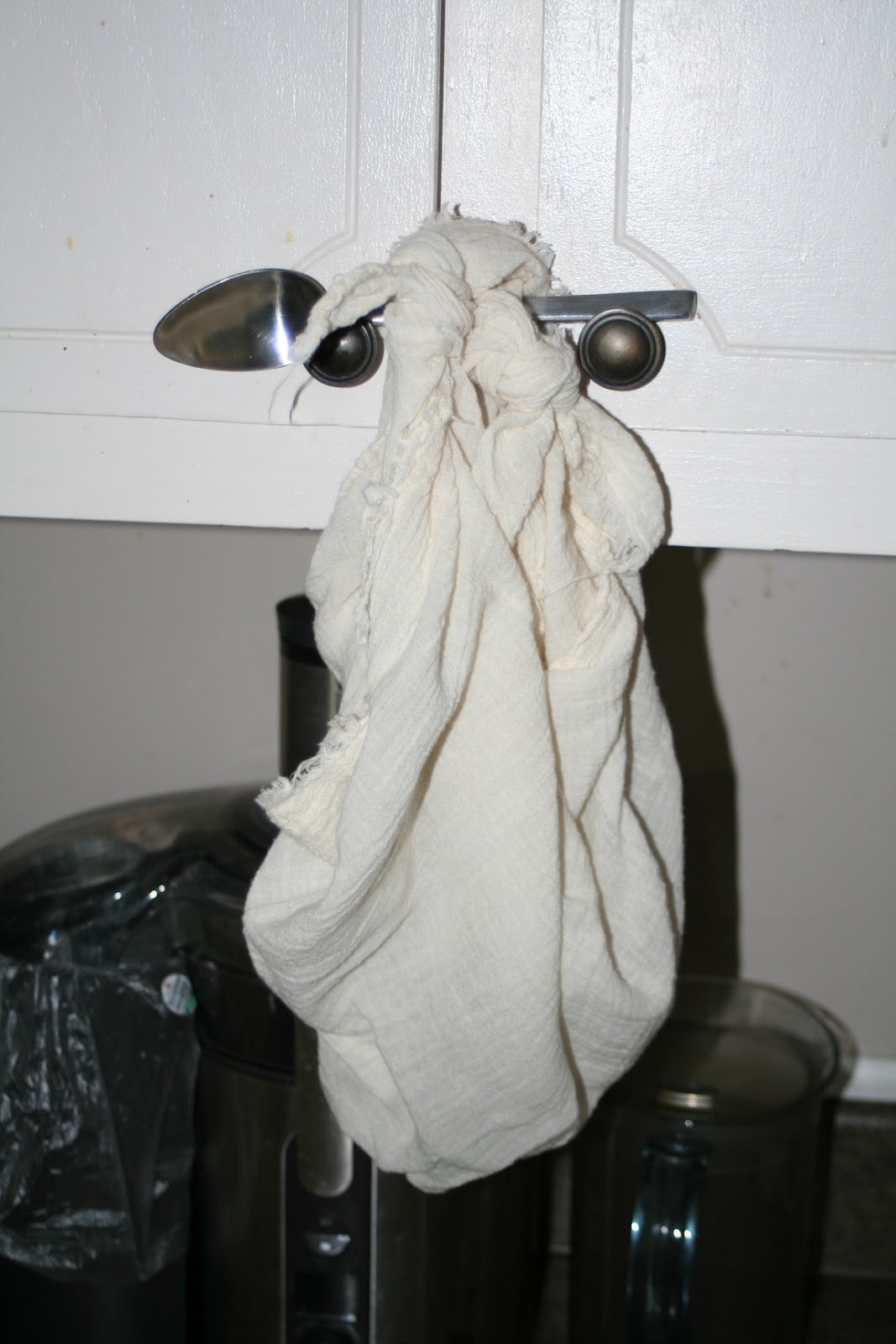
2.  Gather opposite corners and tie them together to suspend.  In the above pic, you can see how I suspend my yogurt/cheeses over my kitchen sink.  I've installed a hook over the sink for this purpose. 

I have seen others who strain like this, though, using kitchen cabinet doorknobs and a kitchen utensil to rig up a way to strain.  Just be sure to set a bowl directly underneath to catch all the excess liquid.

3.  Allow to strain until the desired thickness is achieved, up to 12 hours. 
4.  Transfer to a bowl, refrigerate, enjoy!

Now, in cheesemaking circles, this finished product is actually referred to as Yogurt Cheese.  Left plain, it's basically Greek-style yogurt, but you can salt it a bit to make an excellent spreadable cheese.

Here, I added chopped green onion, parsley, minced garlic, and a dash of lemon juice to create this flavorful cracker spread.

It really is delicious! 

Tuesday, August 14, 2012

2 Good Reasons to Get Your Hands Dirty


This month's issue of World  Ark, Heifer International's magazine, featured a great article on farmers of the world, "Sorry to Eat and Run, But . . ." by J. Malcolm Garcia.  In it, he compares American farmers to farmers in the rest of the world. 

"Subsisitence agriculture, where small farmers grow their own food to feed their families, remains common in developing countries.  The typical subsistence farm includes a variety of crops and animals the family needs to feed and clothe themselves during the year.  Planting decisions are made with an eye toward family needs for the coming year rather than market prices. 

"Roughly 65 percent of sub-Saharan Africa's population relies on subsistence farming.  For instance, 86 percent of Ugandans earn a living through subsistence farming; 85 percent of Angolians also rely on subsistence farming.  Most of the economies of Lesotho, Malawi, Zambia, and Rwanda are also based on subsistence farming."

In the U.S., however, most farms are growing one or two crops, and they're doing it LARGE scale.  "Today, fewer American farmers feed more people than ever before in the history of food production.   . . . And, virtually none of these farmers feeds his or her own family with homegrown crops."

So, even the most successful farmers in the U.S. are not growing to feed their own families.  They have to head to the store to do that.  "Nearly 80 cents of each dollar Americans spend for food goes to pay for marketing services -- processing, packaging, transportation, storage and advertising.  . . . All of these costs are associated with getting food into the most convenient form and packaging, sending it to the most convenient location at the most convenient time, and then convincing us to buy it.  As consumers, we pay far more for the conveniance of our food than for the food itself."

I don't know about you, but I like the idea of being a citizen of the world, connected even to those who are 1/2 a world away.  It's difficult as Americans who have every modern convenience at our fingertips to relate to those in developing countries.  What do we have in common?  What do we share?  Well, lots of things, but one is this:  the land.  We forget that we depend on the land, and most Americans don't act like we need it.  But, the simple act of digging a hole and planting a seed serves to connect us more with the world at large. 

The article encourages, "Gardens are a teacher.  . . . Gardens reconnect us to where food comes from.  People do it to get their hands dirty.  We've taken the tactile experience out of our environment [here in the U.S.].  Convenience has replaced feeling.  We garden because it feels great.  It's very natural."

And, isn't it true?  It seems that we Americans are always conjuring ways to get back to nature:  camping, hunting, fishing, kayaking, gardening.  There's something in us that wants to be there.  And why not?  We were created there.  God didn't speak forth a high-rise apartment building and then create Adam on the 58th floor.  He formed him out of the earth itself and brought him to life in a garden.


What my garden looks like today -- some things are still kickin' despite the drought!

So, this post may seem rambling, but here's what I take from this article -- two good reasons to get your hands dirty and grow something in your own backyard.
1.  It's what most people on this earth that we call home do.  Everyday.  Do it to be in tune with the rest of humanity and to better understand those who seem so distant.
2.  It's what we're meant to do.  It's not a coincidence that you feel more alive floating the river than you do in an office building.  You can create your own nature and "get back" to it in your own yard, everyday.

Monday, August 13, 2012

Curbside Compost


Composting is really catching on.  In fact, though it's hard to imagine here in a town where I still have to haul my own recycling items to the plant myself, many big cities are moving to a three-bin trash pick-up system:  trash, recycling, and compost.  This allows those who don't have the space to compost for themselves a way to reduce landfill trash and help the environment by turning yesterday's orange peel into tomorrow's fertilizer for the local park.

While great for apartment dwellers who may not have a way to benefit from their own compost pile, compost pick-up is not really necessary for most of us.  With the commitment of a little space and time, most house dwellers can make use of rich compost in their own lawns and gardens.

If you've got the space to set up a simple system, get started! 

Of course, anything that grows is fit for the compost, but here's a list of some things you may not have thought of that can also go on the pile:

1. Coffee grounds and filters
2. Tea bags
3. Used paper napkins
4. Pizza boxes, ripped into smaller pieces
5. Paper bags, either ripped or balled up
6. The crumbs you sweep off of the counters and floors
7. Plain cooked pasta
8. Plain cooked rice
9.  Stale bread (of course, if you've got chickens, give items 7-9 to them -- they'll thank you!)
10. Old herbs and spices
11. Wine corks
12. Paper egg cartons
13. Toothpicks
14. Nail clippings
15. 100% Cotton cotton balls
16. Dryer lint
17. Pencil shavings
18. Contents of your vacuum cleaner bag or canister
19. Newspapers (shredded or torn into smaller pieces)
20. Leaves trimmed from houseplants
21. Dead houseplants and their soil
22. Flowers from floral arrangements
23. Used matches
24. Ashes from the fireplace, barbecue grill, or outdoor fire pit
25. Jack o' Lanterns  (it'll be that time before we know it!)

For a more complete list of things you may be surpised can go to the pile, check here.

Sunday, August 12, 2012

Let's Get One Thing Straight

I put forth great effort to feed my family well.  I feed and milk a dairy goat daily to be able to provide us fresh milk, cheese, and yogurt. I scramble up antobiotic-free backyard eggs for breakfast and serve them with fresh-squeezed juices.  I try to avoid super-processed foods and grow what I can in the backyard. 
That said . . . when there's a funnel cake within sniffing distance, all bets are off!
Apparently, it runs in our family.  Here, Girl 1 is wolfing down the remaining powdered sugar. 

Anyway, this funnel cake weakness actually got me thinking about something.  We moms a lot of time suffer from something I call "Mom Guilt."  We all want to be the best moms we can be, but we all have different gifts.  I may do lots of things really well, but when I see other moms doing something "better," I suffer a twinge of guilt as I think, "why can't I be more like that?"  Admit it, you know what I'm talking about.  For you it may be that mom friend who possesses more patience than you think is humanly possible or the one who always squats down and speaks to her children on their level in a calm, even tone, or the one who's taught her 2-year-old to recognize all her letters and numbers, or the one who  . . . I could go on and on. 

I don't want to cause anyone any mom guilt.  So, let it be known that while I post a lot about my successes when it comes to feeding my family better and eating locally produced food, there are maybe just as many failures that I'm not broadcasting for all to see. 

In fact, learning to be more mindful about our food and where its coming from is a journey.  I doubt anyone has ever just woken up one day and thrown out all their Doritos and frozen chicken nuggets before heading to the sale barn to purchase their own goats and chickens, completely trading in one lifestyle for another.  It's a process.  I may be further along the journey than some, but I still have days when I backslide . . . I just don't normally blog about them.

Just so that you don't think we're all wearing organic cotton clothing all the time and eating only foods generated in our own backyard for every meal, let me just recount today for you.

Our small town is celebrating its Watermelon Festival today, so we headed out to Main Street for the parade, at which my children caught approximately 5 pounds of candy that is now sitting on my kitchen counter.  It will, of course, magically disappear overnight, but today, they all indulged.

Following the parade, we discovered that we'd parked in such a bad spot that there was no way in the world we were going to be moving our car anytime soon, and my kids bellies were telling them it was time to eat.  Sonic was within walking distance.  Yep, we did.  We ate Sonic for lunch.  Wait . . . it gets worse.  Girl 2 took a big 'ole bite of her hot dog (made of who knows what), let out a big sigh, and proclaimed "Sonic makes the best food!"   Ahhh!

Following Sonic, we headed to the park, where the festivities were taking place and the kiddos had icecream (not the homemade goats milk frozen yogurt from our freezer at home, but the lard-based soft-serve swirl).

I brought the two youngest kids home (they apparently came down off their sugar highs in the car and both fell asleep in the 2 miles we traveled to get home) where they had naps and dinner before we headed back to the park where the aforementioned funnel cake inhalation went down.

Yep, file this day under parental failure on the food front.  So, go ahead and cross me off that list of moms who cause you Mom Guilt.  It's not a list I'd want to be on anyway!

Whew!  It feels good to get that off my chest.  Now, tune back in later this week when I'll be posting, hopefully, about a food success rather than a failure!